No surprise Clegg has zoomed ahead in the polls.
Sunday, April 18, 2010
Just watched the debate between Nick Clegg, Gordon Brown, and David Cameron, the three major contenders for the prime ministership of Great Britain. Going into it, I figured I'd like what Cameron had to say -- and I did. However, Nick Clegg, leader of the Liberal Democrats and head of that party's "market" wing, really charmed me. I know he's more left of center than he came off, but it was interesting to see someone making the case for semi-classical liberalism. I was especially intrigued by his emphasis on regionalism, decentralization, trade and peaceful intercourse abroad, and the fusion of civil rights and strong policing at home. Also, he eagerly shot down Labour's idiotic and fearsome National ID Card program. He was also a real stickler for hard numbers.

Friday, April 16, 2010
Closer to upset than we think?
Three years ago, the Republican establishment piled scorn on the presidential candidacy of Ron Paul.
Today, he is in a statistical tie with President Obama in 2012 polling.
His son, an ophthalmologist who has never run for elective office, is well ahead of not only the GOP's handpicked candidate for Senate in Kentucky but also both Democratic contenders -- all statewide officeholders.
What happened?
Sunday, April 11, 2010
Friday, April 9, 2010
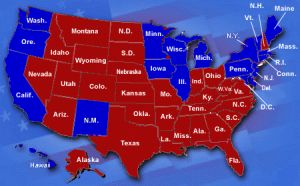
RE: The last post
How many of the GOP's lower middle class big guvmint howlers actually benefit from the oppressive federal levy? You are forced to wonder.
Reminds me tangentially of this interesting imbalance, indicated on the left-side map.
People wonder why there is no tax revolt?
About 47 percent will pay no federal income taxes at all for 2009. Either their incomes were too low, or they qualified for enough credits, deductions and exemptions to eliminate their liability. That's according to projections by the Tax Policy Center, a Washington research organization....In recent years, credits for low- and middle-income families have grown so much that a family of four making as much as $50,000 will owe no federal income tax for 2009, as long as there are two children younger than 17, according to a separate analysis by the consulting firm Deloitte Tax....The result is a tax system that exempts almost half the country from paying for programs that benefit everyone, including national defense, public safety, infrastructure and education. It is a system in which the top 10 percent of earners -- households making an average of $366,400 in 2006 -- paid about 73 percent of the income taxes collected by the federal government.
The bottom 40 percent, on average, make a profit from the federal income tax, meaning they get more money in tax credits than they would otherwise owe in taxes. For those people, the government sends them a payment.
Tuesday, April 6, 2010
A wealthy young Republican donor and former member of the "Young Eagles" -- a program that is supposed to make the GOP fun again, or something -- said in reaction to Bondagegate:
Everything that's cool from a pop culture perspective is Democratic, whether it's Kanye West or Bruce Springsteen . . .
I'm reminded suddenly of Freddie's recent Wunderkammer article:
To call the Burkean insight a project or mission would be, I suppose, exactly wrong. But however we might want to frame it, it is clear that Burkeanism has failed utterly to maintain a hold on the communal imagination of movement conservatism. Convinced of the necessity of imprinting the conservative brand onto even the most elementary of human experiences, conservatives have come to look for ideological status (and thus ideological battle) in the narrowest crevices of day-to-day life. This has led to the sprawling industry of providing "conservative alternatives," in the realm of commodities or media, to conservative people. It is now entirely easy for someone to consume only conservative-oriented media at every level: conservative magazines, conservative radio, conservative television and news, conservative websites. Broader still, there are conservative dating services, conservative coffee houses, conservative colleges, conservative financial services, conservative rock music, a conservative YouTube....Often explicit, always obvious, these conservative-situated alternatives send the inescapable message: there is no end to the political; all of human life is a part of an endless ideological struggle; nothing is to be considered free from the quest for conservative purity.
I can't even imagine considering Kanye West in political terms, yet those on the mainstream right seem more and more committed to viewing everything through the crude filter of ideology. Think of how often you hear conservatives lament "art for art's sake," just like the old time reds. The vulgarization of conservatism is intimately related to conservatives' vulgarization of life itself; to their pathetic inability to distinguish and appreciate the various modes of human existence.
Monday, April 5, 2010
Random, and rough, thought during work today: Liberals recognize that Americans are a non-martial people*, but they do not understand the martial reality of our imperial commitment. Conservatives** do not recognize that Americans are a non-martial people, but they better understand the martial reality of our imperial commitment.
*We verged, after two major world wars and a decade of hunger and poverty, on becoming a martial people, but the cultural revolt of the '60s and '70s (which crossed generational, class, and sex lines) not only ended but reversed the process.
**Here I mean conservatives of the mainstream, not antiwar.com readers/Buchananites/paleos, and so on.
*We verged, after two major world wars and a decade of hunger and poverty, on becoming a martial people, but the cultural revolt of the '60s and '70s (which crossed generational, class, and sex lines) not only ended but reversed the process.
**Here I mean conservatives of the mainstream, not antiwar.com readers/Buchananites/paleos, and so on.
Sunday, April 4, 2010
Politics may be an unlovely business in many respects, but to Churchill's mind it is the most significant vocation a man can have, and its detractors cut themselves off from life's vital force.
Only a European -- or a Young Republican/Democrat -- could conceive of politics as "life's vital force."
We were not aware that civilization was a thin and precarious crust erected by the personality and the will of a very few, and only maintained by rules and conventions skillfully put across and guilefully preserved. We had no respect for traditional wisdom and the restraints of custom.
This be the case? Is civilization a delicate artifice perpetrated with painful deliberateness by a legalistic elite against the mass of brutes? Or do men easily co-exist in a decent, peaceful and prosperous fashion, with order disrupted by schemers who take advantage of the majority's good nature to exploit and oppress?
My thoughts on the way, but I will say in advance that I'm often surprised by which side people choose.
Saturday, April 3, 2010
What philosophical thesis do you think it most important to combat? > Communism in all its incarnations.
What year is it again? The right wing fights the ghosts of the past because it is unable to produce a cogent analysis of the present and its immediate threats, at least without relying on old, misfitting formulas (Islamism as fascism, antiwar folks as appeasers, etc.).
Friday, April 2, 2010
Priceless: Dedicated red-and-blacks drinking Pepsi and Starbucks at an anarchist conference. Fight the power!
Our country has, for more than a century now, been what can crudely be called "Progressive."
At this point, the Progressives are the conservatives, and those extreme right wingers who seek to eviscerate the paternal state are the radicals.
The revolution is over. "The Revolution Was." Generations ago minimalist-decentralists lost. And lost bad. Reagan nodded in their direction but achieved little more than turning a respectable philosophy into a rigid ideology.
I'm in the midst of writing an essay on this exact topic. Look for it soonish.
For what it's worth, I sympathize with the minimalist-decentralist position. It's just that I realize that said inclination has never been as pronounced a feature of the American character as right wingers like to claim. Certainly, for all our superficial whining about "big government," the vast majority of Americans remain fond of the major entitlements.
People -- especially modern people -- will almost always trade autonomy for security. (Wasn't that the whole premise of the Bush administration?) And they do so without considering themselves opposed to liberty, because security constitutes the very basis of modern liberty, which is thoroughly positive.
The right likes to accuse the left of living in a fantasy world, yet it is the latter who currently possess absurd faith in the individual. Liberals seem now to grasp the basic truth about men: That they are frail and weak and will eagerly trade rights for entitlements.
"Keep your hands off my gun . . . and my dole!"
At this point, the Progressives are the conservatives, and those extreme right wingers who seek to eviscerate the paternal state are the radicals.
The revolution is over. "The Revolution Was." Generations ago minimalist-decentralists lost. And lost bad. Reagan nodded in their direction but achieved little more than turning a respectable philosophy into a rigid ideology.
I'm in the midst of writing an essay on this exact topic. Look for it soonish.
For what it's worth, I sympathize with the minimalist-decentralist position. It's just that I realize that said inclination has never been as pronounced a feature of the American character as right wingers like to claim. Certainly, for all our superficial whining about "big government," the vast majority of Americans remain fond of the major entitlements.
People -- especially modern people -- will almost always trade autonomy for security. (Wasn't that the whole premise of the Bush administration?) And they do so without considering themselves opposed to liberty, because security constitutes the very basis of modern liberty, which is thoroughly positive.
The right likes to accuse the left of living in a fantasy world, yet it is the latter who currently possess absurd faith in the individual. Liberals seem now to grasp the basic truth about men: That they are frail and weak and will eagerly trade rights for entitlements.
"Keep your hands off my gun . . . and my dole!"
Thursday, April 1, 2010
I do wonder if Conor Friedersdorf shall have recovered from the encounter with Valley of the Shadow on Twitter in time to meet some actual Americans. Come chill with the homies, Conor: we’re generally good folk, after all.
Any citizen of this country is an "actual" American.
This exclusionism is a frightening and unsavory tendency of the modern right: "You are American, you are not."
Smacks of papist excommunication and Stalinist purging.
What might be the case, but we can't know, is that there are problems that we are similarly unaware of.
This dilemma is not restricted solely to the pursuit of scientific, empirical conclusions. It also bedevils moral reasoning. It makes challenging the justification of your long dead heroes. They're all slave owners and mass murderers and wife beaters and rabid anti-Semites, right?
Attitudes and actions presently deemed intolerable: Are they excused (or explained) by so-called "prevailing standards"?
Even in Jefferson's day, sound minds proffered excellent and logical objections to slavery. Jefferson knew these objections. How then can we hail him, this possessor and driver of human flesh? Ah, context, and so on.
Is that it? Is all right and wrong reducible to mis-en-scene?
The dilemma Freddie suggests frustrates an interest in How Things Are, but it absolutely shatters an interest in How Things Should Be.
What if our children's children see us as monsters? "Mom, why doesn't grandpop understand my love for Joe? So what if he's cyber? He's my one, my only! Why can't the old bastard get it"
Mm?
A student of history understands life to be the gradual repudiation of most everything you think real and right and relevant. Ah well.
Wednesday, March 31, 2010
I knew it was a shocking thing to say. No one has the right to live without being shocked. No one has the right to spend their life without being offended. Nobody has to read this book. No one has to pick it up. No one has to open it. If they open and read it they don’t have to like it and if you read it and dislike it you don’t have to remain silent about it. You can write to me, you can complain about it, write to the publisher, write to the papers, write your own book. You can do all those things, but there your rights stop. No one has the right to stop me writing this book. No one has the right to stop it being published or sold or bought or read and that’s all I have to say on that subject. --Philip Pullman
 ed by a sagging economy and backbreaking unemployment rate.
Monday, March 29, 2010
The skeptic doesn't deny man's ability to reach discrete truths after significant empirical observation, but he does insist that we recognize any supposedly definitive conclusions as the product of an often faulty biological processor whose contact with the objects of its analyses is mediated through dense and wildly distorting cultural and biological filters. We're working on a second hand basis here -- at best.
The funny thing about devout atheists is that many tend to be human triumphalists, with utopian -- borderline religious -- philosophies of the mind (or brain, depending). This from the same people who conceive of us as beasts pure and simple, the kith and kin of apes. Yet grandiose imaginings of our mental capacity persist in that camp. Consider Hitchens, whose sense of "right" and "wrong" is hyper-cultivated, and who possesses fraternal ideal that would put to shame the most zealous Christian millenarians.
I think science has managed to arrive at a number of impressively sound conclusions. Of course, most every one of them emerged in the last 2 or 3 of our species' 2000 centuries. And only with the ceaseless struggle of a class of highly intelligent specialists working 'round the clock.
Even those truths which appear most secure I take with a large grain of salt. After all, we're frail animals with limited perceptions, unstable starting points, shoddy reasoning powers; animals bound always to look through a mirror, darkly.
Put simply, when it comes to truth, our track record isn't very encouraging.
The funny thing about devout atheists is that many tend to be human triumphalists, with utopian -- borderline religious -- philosophies of the mind (or brain, depending). This from the same people who conceive of us as beasts pure and simple, the kith and kin of apes. Yet grandiose imaginings of our mental capacity persist in that camp. Consider Hitchens, whose sense of "right" and "wrong" is hyper-cultivated, and who possesses fraternal ideal that would put to shame the most zealous Christian millenarians.
I think science has managed to arrive at a number of impressively sound conclusions. Of course, most every one of them emerged in the last 2 or 3 of our species' 2000 centuries. And only with the ceaseless struggle of a class of highly intelligent specialists working 'round the clock.
Even those truths which appear most secure I take with a large grain of salt. After all, we're frail animals with limited perceptions, unstable starting points, shoddy reasoning powers; animals bound always to look through a mirror, darkly.
Put simply, when it comes to truth, our track record isn't very encouraging.
Wednesday, March 10, 2010
Former Clinton advisor William Galston sums up the matter this way: you need only do three things in this country to avoid poverty—finish high school, marry before having a child, and marry after the age of 20. Only 8 percent of the families who do this are poor; 79 percent of those who fail to do this are poor.
James Q. Wilson
Tuesday, March 9, 2010
Yuppie-in-chief:
In France, high-speed rail has pulled regions from isolation, ignited growth [and], remade quiet towns into thriving tourist destinations.
Saturday, March 6, 2010
I have no doubt that it is your intention to be the quiet assassin of European democracy and of the European nation-states.
My new hero, Nigel Farage.
Wednesday, March 3, 2010
Meghan McCain is an argument against hereditary government.
While attacking the tea party movement on the View, she said:
Revolutions?
Ol' skooool in da house!
While attacking the tea party movement on the View, she said:
Revolutions start with young people, not with 65-year-old people talking about literacy tests and people who can’t say the word vote in English. It’s ridiculous.
Revolutions?
McCain has also repeatedly called for “Old School” Republicans to embrace progressives like herself.
Ol' skooool in da house!
Monday, March 1, 2010
Writes Freddie in an otherwise decent article:
Freddie usually takes care with words. This bit is uncharacteristically sloppy. Perhaps that's the point, to rile folks up? Anyway.
Much of the revolution's foundational rhetoric evinced vivid egalitarianism, but was the struggle’s animating philosophy “left-wing” in any meaningful sense? Perhaps, when he says “left-wing,” Freddie simply means republican, anti-royalist, and (sort of) secular. In that case, America was at the forefront of international leftism in its struggle against the Central Powers. (And anyway, the Romans who overthrew the Etruscans were anti-royalist republicans. Were they "at the absolute vanguard of left-wing philosophy for their times"?)
The revolution had its share of radical democratic cosmopolitans, sure. But for every Tom Paine there was a slave-owning aristocratic quasi-feudalist. Or a bourgeois monarchist in the mold of Hamilton.
Seems to me—and here I know I’m getting away from Freddie’s point—that the driving force behind the revolution was nationalism. There emerged in the thirteen colonies a patriotic sensibility. Home was no longer Britain but America (or Virginia, Massachusetts, whatever). Most partisans fought not out of any commitment to political or economic leveling, but because they were sick of some distant king dispatching goons to thieve their hard-earned pennies and impose arbitrary laws from afar. (Eventually, and soon in some circumstacnes, these impulses coalesced into a general governing philosophy that put a premium on liberty and constitutionalism, with the narrative flourishes coming much later.)
The revolution, for all its liberal trappings, was not an ideological affair, which is why there was a minimum of internecine brutality between patriots and tories. This imagining—pragmatic, nationalistic, and vaguely localist—cuts against both the conceptions of both the left and the right. The spirit of 1776 was neither egalitarian nor libertarian. It was nationalistic. (Which should really make Freddie happy, since his "ultra-leftism" depends upon group consciousness and solidarity and the centralizing impulse to succeed.)
The outcome produced greater equality for a few. Certainly, white males of means witnessed an increase in their political rights and liberties, though in many senses it was not a dramatic expansion. And for blacks, the greatest single oppressed minority in American history, the success of the revolution likely prolonged their bondage. The struggle against Britain was in that sense reactionary, or stereotypically "right-wing."
“[T]his is a country born out of violent revolution by men at the absolute vanguard of left-wing philosophy for their times.”
Freddie usually takes care with words. This bit is uncharacteristically sloppy. Perhaps that's the point, to rile folks up? Anyway.
Much of the revolution's foundational rhetoric evinced vivid egalitarianism, but was the struggle’s animating philosophy “left-wing” in any meaningful sense? Perhaps, when he says “left-wing,” Freddie simply means republican, anti-royalist, and (sort of) secular. In that case, America was at the forefront of international leftism in its struggle against the Central Powers. (And anyway, the Romans who overthrew the Etruscans were anti-royalist republicans. Were they "at the absolute vanguard of left-wing philosophy for their times"?)
The revolution had its share of radical democratic cosmopolitans, sure. But for every Tom Paine there was a slave-owning aristocratic quasi-feudalist. Or a bourgeois monarchist in the mold of Hamilton.
Seems to me—and here I know I’m getting away from Freddie’s point—that the driving force behind the revolution was nationalism. There emerged in the thirteen colonies a patriotic sensibility. Home was no longer Britain but America (or Virginia, Massachusetts, whatever). Most partisans fought not out of any commitment to political or economic leveling, but because they were sick of some distant king dispatching goons to thieve their hard-earned pennies and impose arbitrary laws from afar. (Eventually, and soon in some circumstacnes, these impulses coalesced into a general governing philosophy that put a premium on liberty and constitutionalism, with the narrative flourishes coming much later.)
The revolution, for all its liberal trappings, was not an ideological affair, which is why there was a minimum of internecine brutality between patriots and tories. This imagining—pragmatic, nationalistic, and vaguely localist—cuts against both the conceptions of both the left and the right. The spirit of 1776 was neither egalitarian nor libertarian. It was nationalistic. (Which should really make Freddie happy, since his "ultra-leftism" depends upon group consciousness and solidarity and the centralizing impulse to succeed.)
The outcome produced greater equality for a few. Certainly, white males of means witnessed an increase in their political rights and liberties, though in many senses it was not a dramatic expansion. And for blacks, the greatest single oppressed minority in American history, the success of the revolution likely prolonged their bondage. The struggle against Britain was in that sense reactionary, or stereotypically "right-wing."
Old but interesting self-criticism of the NYT's liberal bias by its (now former) ombudsman.
I once found myself nursing a hangover in Nowhere, Dixie.
The waiter came over, clean-faced and sun-browned. "Mornin', folks," he said in a sunny southern drawl.
"Booze?" I croaked.
"Oh, no, we don't do that," he laughed, sort of.
Fine. Eggs, I ordered, and bacon and biscuits. With "gravy," or whatever.
"That'll be it?" smiled the waiter.
"The paper. The New York Times."
A darkish look settled across his face. "Oh," he said flatly. "Oh, no, we don't do that."
He returned to the counter and whispered with the other waiters, glancing conspiratorially in my direction. Damnyank. The food was fine: heavy, savory, liberally salted. The USA Today was worse than the damn hangover.
But if you're examining the paper's coverage of these subjects from a perspective that is neither urban nor Northeastern nor culturally seen-it-all; if you are among the groups The Times treats as strange objects to be examined on a laboratory slide (devout Catholics, gun owners, Orthodox Jews, Texans); if your value system wouldn't wear well on a composite New York Times journalist, then a walk through this paper can make you feel you're traveling in a strange and forbidding world.
I once found myself nursing a hangover in Nowhere, Dixie.
The waiter came over, clean-faced and sun-browned. "Mornin', folks," he said in a sunny southern drawl.
"Booze?" I croaked.
"Oh, no, we don't do that," he laughed, sort of.
Fine. Eggs, I ordered, and bacon and biscuits. With "gravy," or whatever.
"That'll be it?" smiled the waiter.
"The paper. The New York Times."
A darkish look settled across his face. "Oh," he said flatly. "Oh, no, we don't do that."
He returned to the counter and whispered with the other waiters, glancing conspiratorially in my direction. Damnyank. The food was fine: heavy, savory, liberally salted. The USA Today was worse than the damn hangover.
Sunday, February 28, 2010
Religion, our great neurosis. This temple, our great anchor.
Civilization, not the result of rational plotting, but beautiful, horrible compulsion. Humans as manic obsessives, incessantly planning, calculating, measuring, recording, projecting, estimating.
Witness culture, art. Someone once remarked that we prefer not even to consider how closely the practice of writing, especially fiction writing, resembles mental illness, with the creator sitting alone for days, months, years, muttering to himself, conjecturing "plots."
See also, sort of: World of Path, Orson Scott Card.
What's wrong with being neurotic? Bullshitting bullshitter here.
Seems religion has more civilizing effects on man than I thought:
Still, not sure how even a rudimentary temple -- forget something so grand and complicated -- could be constructed without the sort of technologies only produced by generations of intellectual labor. And how could such specialized activities occur except within the confines of a rooted society? Seems sort of cart-before-horse.
Even so, this is a pretty incredible find: A vast, beautiful temple complex predating the great pyramids by many thousands of years. A magnificent testament to human existential angst and ecstasy and our need for the organized working out of such. If worship sparked civilization, is it not essential sustenance?
The church is to me not some symbol of repression, ignorance, and backwardness, but rather an impressive sophistication of manners. The church signals the maturity of the human spirit, its adulthood not its infancy. It is one of the great products of the human heart, intellect, and imagination.
Still, not sure how even a rudimentary temple -- forget something so grand and complicated -- could be constructed without the sort of technologies only produced by generations of intellectual labor. And how could such specialized activities occur except within the confines of a rooted society? Seems sort of cart-before-horse.
Even so, this is a pretty incredible find: A vast, beautiful temple complex predating the great pyramids by many thousands of years. A magnificent testament to human existential angst and ecstasy and our need for the organized working out of such. If worship sparked civilization, is it not essential sustenance?
Saturday, February 27, 2010
Friday, February 26, 2010
Ah, America:
I’m sure ALL republiscum/conservatards share the same sentiment. They are all racists to the core.In most societies, “crazy” people are kept on the fringes. In America, they get elected as Republican politicians.GOP = KKK in neck-ties.
Sad thing is, these comments were made by anonymous interneteurs of amusing intelligence, while statements equally distressing and moronic are made every day by filthy rich and horrifyingly famous gasbags like Rush Limbaugh. Despite the vast and hilarious idiocy of the liberal netroots, I stand by Nixon's assertion that the only thing worse than a left wing extremist is a right wing extremist.
To hell, partisanship, to hell.
Hats off to Pat Deneen, who flourishes a declaration I've been clinging to for some time now: "I am religious, not spiritual."
Nothing riles like this kind of warmed over, pseudo-oriental, "I'm spiritual, not religious." It's the cop-out of all cop-outs. It's lazy and indulgent, an assumption of piety without any pretense of sacrifice. It aspires to sound enlightened when really it is the mark of a supremely uncultivated mind (or, if we're being bold, soul). It is nothing more than a thoughtless retreat to the habits of early humans, whose anxieties and desires manifested in the worship of gross objects or a sort of prostration before an abstract, panentheistic godhead.
Many in the west have been tricked into thinking that this shapeless mysticism is revolutionary, a swell advance, praiseworthy. "Yes," they cry, "now we are free of the mean priests with their wagging fingers, free of the rabbis with their judging eyes, free of heavy books of prayer and prejudice!"
This is a sure sign that egalitarianism has utterly infected not just our political discourse but also our existential practices. (I prefer "existential" to "spiritual," as it connotes a more objective, philosophical approach to these obscure anxieties and desires that seem to animate all people and defy easy empirical explanation. The term is explicitly neutral on the potential of dualism, that is, matter and spirit coexisting in the same form.)
I don't value so much the twitching of my inner self, its fear of oblivion or hope for salvation. So humans are oriented, perhaps, toward another world, even if it's one of our own making, so what? What I do value are the stabilizing, clarifying institutions related to these existential utterances. If there was no god, religion would be more necessary than ever before.
The church is to me not some symbol of repression, ignorance, and backwardness, but rather an impressive sophistication of manners. The church signals the maturity of the human spirit, its adulthood not its infancy. It is one of the great products of the human heart, intellect, and imagination.
With its bizarre fabric of rules and admonitions and commandments, the church forces man from his comfort zone, forces him to deal a little more honestly with the darkness within and without. This process humbles, it makes us prudential and modest, while the cheap ecstasy of contemporary spiritually encourages megalomania, delusions of grandeur.
"Organized faith" (horrible term), despite its many abuses, provides a basis for existential discipline neither required nor really even possible in the lax DIY realm of individual spiritually. In this sense, formal religion is supremely liberating while spiritually (as a distinctive popular "practice") is supremely confining, amounting to little more than solipsistic devotion to the fear and trembling of one inner-self.
Thursday, February 25, 2010
This hilarious and depressing and weirdly arousing Standard piece about contemporary dating got me thinking.
Thinking about progress, myth of. Post-Enlightenment, occidental man is gripped by the notion that we are, or have, 'advanced,' that we are slowly but steadily ascending a pyramid to some utopian state where everyone is great, everything swell.
Nothing is more absurd than this, the teleology delusion.
While technology has admittedly grown more complex, other areas of our society have experienced alarming corruption or degradation. Among them, courtship rituals. Also, language, which has undergone extensive simplification. Though functional literacy has increased, what might be called 'deep literacy' has devolved at a staggering rate.
We are not moving upward or forward. Nor are we moving downward or backward. Both are equally strange notions. Human civilization is like a collection of billiards on a pool table, some of the balls large and some tiny and some middle-sized, each for every institution and individual in the world. These billiard balls are ever colliding, smashing and interrupting and intercepting and jostling one another in ways sometimes predictable but more often surprising. Yet for all their movement, they remain on a level plain, and as time passes some shrink and disappear, others swell and explode, but never do they stack, never do they fall. The motion is random and horizontal, not methodical and vertical. (This is Oakeshottian imagery, no?)
I think!
Thinking about progress, myth of. Post-Enlightenment, occidental man is gripped by the notion that we are, or have, 'advanced,' that we are slowly but steadily ascending a pyramid to some utopian state where everyone is great, everything swell.
Nothing is more absurd than this, the teleology delusion.
While technology has admittedly grown more complex, other areas of our society have experienced alarming corruption or degradation. Among them, courtship rituals. Also, language, which has undergone extensive simplification. Though functional literacy has increased, what might be called 'deep literacy' has devolved at a staggering rate.
We are not moving upward or forward. Nor are we moving downward or backward. Both are equally strange notions. Human civilization is like a collection of billiards on a pool table, some of the balls large and some tiny and some middle-sized, each for every institution and individual in the world. These billiard balls are ever colliding, smashing and interrupting and intercepting and jostling one another in ways sometimes predictable but more often surprising. Yet for all their movement, they remain on a level plain, and as time passes some shrink and disappear, others swell and explode, but never do they stack, never do they fall. The motion is random and horizontal, not methodical and vertical. (This is Oakeshottian imagery, no?)
I think!
I arrived at what I am forced to call "conservatism" by way of extreme skepticism.
I admit that there is something like nature and reality, but maintain that we glimpse such objectives only "through a glass, darkly," and that even the stablest, most empirically rigorous data set is the mere product of human cognition, a feeble and faulty thing at best, and a totally and dangerously delusional thing at worst.
With all knowledge subject to doubt, modesty and prudence must rule the practice of politics.
We can agree that when it comes to navigating through darkness, you sticks to the basics. Imagine walking through an unlit room at midnight. You keep your hand to the wall, maybe, or walk in a deliberate, plodding shuffle. You don't take off at a full sprint, even if you do have in your head some conceptual map of the room, some plan of navigation.
That's because you recognize, at least semi-consciously, the limitations of your own mind. Why rely on abstraction when you can rely, point-to-point in a practical manner, on your senses, on discreet steps which figure, in the most basic manner, "if this, alright, then that."
If you do choose to sprint, you crash your shin into a chair or bust your nose against a refrigerator, whatever.
Yet, despite ours fundamental ignorance, we humans have managed to develop certain systems that protect our needs, nurture our desires, and fulfill basic instincts and urges. Those associations which are ancient and organic have proven their worth by virtue of longevity and must typically be given prejudicial treatment, not because they are 'good' or 'ideal,' but because they have been educated by generations of the old plod and shuffle of daily existence, trimmed and shaped from this direction and at that angle by the awesome variety of human experience.
My reservations regarding verifiability and modes of empiricism which attempt large rather than small statements may seem to put me in the postmodern camp. However, as Slavoj Zizek effectively demonstrates, early in its emergence modernity was a very humble affair.
Liberalism, modernity's initial political manifestation, stated simply and elegantly: "Yes, we have different existential outlooks; no, we cannot seem to resolve them short of reducing our whole civilization to ash; okay then, let us agree to disagree in a kind of demilitarized zone and . . . voila, secular civil space, a prefiguring of the libertarian idyll." So perhaps I am actually proto-modern? Or something?
I need a drink.
I admit that there is something like nature and reality, but maintain that we glimpse such objectives only "through a glass, darkly," and that even the stablest, most empirically rigorous data set is the mere product of human cognition, a feeble and faulty thing at best, and a totally and dangerously delusional thing at worst.
With all knowledge subject to doubt, modesty and prudence must rule the practice of politics.
We can agree that when it comes to navigating through darkness, you sticks to the basics. Imagine walking through an unlit room at midnight. You keep your hand to the wall, maybe, or walk in a deliberate, plodding shuffle. You don't take off at a full sprint, even if you do have in your head some conceptual map of the room, some plan of navigation.
That's because you recognize, at least semi-consciously, the limitations of your own mind. Why rely on abstraction when you can rely, point-to-point in a practical manner, on your senses, on discreet steps which figure, in the most basic manner, "if this, alright, then that."
If you do choose to sprint, you crash your shin into a chair or bust your nose against a refrigerator, whatever.
Yet, despite ours fundamental ignorance, we humans have managed to develop certain systems that protect our needs, nurture our desires, and fulfill basic instincts and urges. Those associations which are ancient and organic have proven their worth by virtue of longevity and must typically be given prejudicial treatment, not because they are 'good' or 'ideal,' but because they have been educated by generations of the old plod and shuffle of daily existence, trimmed and shaped from this direction and at that angle by the awesome variety of human experience.
My reservations regarding verifiability and modes of empiricism which attempt large rather than small statements may seem to put me in the postmodern camp. However, as Slavoj Zizek effectively demonstrates, early in its emergence modernity was a very humble affair.
Liberalism, modernity's initial political manifestation, stated simply and elegantly: "Yes, we have different existential outlooks; no, we cannot seem to resolve them short of reducing our whole civilization to ash; okay then, let us agree to disagree in a kind of demilitarized zone and . . . voila, secular civil space, a prefiguring of the libertarian idyll." So perhaps I am actually proto-modern? Or something?
I need a drink.
Wednesday, February 24, 2010
Ours can largely be summed up as a localist, decentralist, anarcho-Christian and authentically conservative approach to politics and culture. As we have written previously, we believe that to suffer one’s place and one’s people in the particularity of its and their needs is the only true basis for finding love, friendship, and an authentic, meaningful life. This is nothing less than the key to the pursuit of Christian holiness, which is the whole of the Christian adventure: to live in love with the frailty and limits of one’s existence, suffering the places, customs, rites, joys, and sorrows of the people who are in close relation to you by family, friendship, and community--all in service of the truth, goodness, and beauty that is best experienced directly. The discipline of place teaches that it is more than enough to care skillfully and lovingly for one’s own little circle, and this is the model for the good life, not the limitless jurisdiction of the ego, granted by a doctrine of choice, that is ever seeking its own fulfillment, pleasure, and satiation.
Caleb Stegall and Dan Knauss
A real American conservative, to me, is someone who understands that markets are the best means of allocating resources, that liberty is essential to human thriving, and that man is sinful and in desperate need of checking and elevating institutions like the Church and marriage and childrearing. A real American conservative believes in aspiring, at the very least, to truthfulness and humility and thoughtfulness, which means he can’t help but cringe when he hears the likes of an Ann Coulter bellowing about her enemies being traitors. A real American conservative understands that the ills of mankind will not go away if we could only just have a lower tax rate and less regulation. A real American conservative is not, I’ll submit to you, at home in the maneuvering and manipulation of state capitols, and certainly not in Washington, D.C. A real American conservative does not trust large government or mass democracy or even himself, certainly not himself, which is why he wants to keep undivided power out of any man’s hands, including his own.
Tony Woodlief
I don't begrudge these activists their views and they are entitled to use the term "conservative" to describe themselves if they so choose. But the views many of them profess have little in common with the distinctly American kind of conservatism that gave birth to CPAC and the modern American conservative movement. Instead, what many of today's self-proclaimed "conservatives" proclaim is an ideology borrowed from what Donald Rumsfeld famously dismissed as "old Europe." Winston Churchill, one of Europe's better-known conservatives, was half-American and his incredible strength of character helped Great Britain survive World War II, but when asked to define conservatism, Churchill responded that conservatism was about reverence for king and church. But America has no king and has no national church. That distinction is crucial and one in which today's so-called conservatives have switched sides; crossed the ocean, if you will.
What distinguished modern American conservatism was that it had its roots not in the British kings, but in John Locke and Adam Smith and other champions of individual liberties and individual empowerment. European conservatism--the kind that has now become the rage for the American Right--was top-down and centered on state power. The rise of modern American conservatism, on the other hand, had a distinctly Madisonian flair, embracing the fundamentals of American constitutional limits on central authority. European conservatism found its voice in magisterial decree, religious edict, and acts of parliaments in which members may or may not have ever visited the communities they were presumed to "represent." American conservatism found its voice in a Constitution that placed every major power in the hands of the people, through their representatives, and ensured that those representatives would actually be residents of the communities that elected them. American conservatism embraced a Constitution that separated and constrained powers, that specified --highlighted--a few of the protected liberties of the people coupled with clear assertions that all undelegated powers--all other unsurrendered liberties--remained with the people rather than the government. A Constitution that placed unambiguous limitations, including direct prohibitions, on the attempted exercise of governmental authority.
Mickey Edwards
Monday, February 22, 2010
Dennis Prager asks Andrew Sullivan how he reconciles his conservatism with his support of court-mandated 'rights' that defy the majority view. Prager cites the case of Massachusetts, where the black robes have advanced gay marriage against the will of the people and even the legislature.
The mind baffles. Isn't, in the conservative schema, the government's single most legitimate function the protection of rights and liberties of individuals, particularly against the prejudicial whims of the majority? You can argue that marriage isn't a right or liberty, but in the abstract I don't understand Prager's confusion with this focal rightist principle. The courts are crucial for this exact purpose: To circumvent or supercede democratic decisions for the sake of furthering liberty and defending rights. When the many, through the coercion of the state, attempt to impose moral and cultural particulars that chafe the freedom of the few, that is popular sovereignty gone bad; that is frightening overreach, the tyranny of the crowd so feared by ancient philosophers.
The current conservative animosity toward the judiciary is proof positive of the movement's corruption by populist anti-establishmentarianism. So many conservatives claim to be "constitutionalists," yet especially during the reign of Bush II, they evinced great distaste for separation of powers and checks and balances. During that period, at least on the national level, they became rabid executivists, cold to the courts and congress unless they advanced the will of the presidency, an office now vested with potentially unlimited, dictatorial powers, if that's what the circumstances demanded.
Now that Obama is in the White House, their caesarism has calmed, but only because the mighty weight of the imperial office is now stacked against them. Funny how they decry Obama as a king for excercising the very powers they rigged into the office from 2000 - 08. Turn about may not be fair play, but it sure is fair irony. Republicans are sort of more on board with republicanism now, but just wait a cycle or two.
The mind baffles. Isn't, in the conservative schema, the government's single most legitimate function the protection of rights and liberties of individuals, particularly against the prejudicial whims of the majority? You can argue that marriage isn't a right or liberty, but in the abstract I don't understand Prager's confusion with this focal rightist principle. The courts are crucial for this exact purpose: To circumvent or supercede democratic decisions for the sake of furthering liberty and defending rights. When the many, through the coercion of the state, attempt to impose moral and cultural particulars that chafe the freedom of the few, that is popular sovereignty gone bad; that is frightening overreach, the tyranny of the crowd so feared by ancient philosophers.
The current conservative animosity toward the judiciary is proof positive of the movement's corruption by populist anti-establishmentarianism. So many conservatives claim to be "constitutionalists," yet especially during the reign of Bush II, they evinced great distaste for separation of powers and checks and balances. During that period, at least on the national level, they became rabid executivists, cold to the courts and congress unless they advanced the will of the presidency, an office now vested with potentially unlimited, dictatorial powers, if that's what the circumstances demanded.
Now that Obama is in the White House, their caesarism has calmed, but only because the mighty weight of the imperial office is now stacked against them. Funny how they decry Obama as a king for excercising the very powers they rigged into the office from 2000 - 08. Turn about may not be fair play, but it sure is fair irony. Republicans are sort of more on board with republicanism now, but just wait a cycle or two.
Sunday, February 21, 2010
Gavin McInnes: Hipster-con(stitutionalist)?
For someone who bills himself as a "race-mixing, gay-loving, pro-choice, atheist, anarchist who hates all liberals [ed: and probably next-to-all conservatives]," he says some pretty right-on stuff. Also, he loves John "The 'Stache" Stossel. Word.
Then he shows us the endless piles of documentation the government uses for even the most insignificant rule. “This is all we need,” he says holding up the small book. That’s the closest I’ve seen to a plausible anarchist goal in America—ever.
For someone who bills himself as a "race-mixing, gay-loving, pro-choice, atheist, anarchist who hates all liberals [ed: and probably next-to-all conservatives]," he says some pretty right-on stuff. Also, he loves John "The 'Stache" Stossel. Word.
The extension of marriage to gays and lesbians is a legitimate conservative goal. Here's why: +8m, +24m, +52m.
Wednesday, February 17, 2010
Two letters from August 1776 exchanged between John and Abigail Adams. In them, Abigail signs her name "Portia" after the wife of the Roman Senator Brutus. The letters are filled with classical references and ideas of republican virtue.
What nom de plume would Michelle Obama adopt?
"The profound and pervasive legacy of ancient Rome is deeply embedded in the western culture of today; the lasting effects of Roman domination can be found almost anywhere," said Linda Carioni of Contemporanea Progetti. "They can be seen in our judiciary and monetary systems, in our art and architectural patrimony, in the modern Romance languages, in our alphabet of 26 letters, as well as the calendar of Julius Caesar."
What the hell lobby is behind this emerging campaign against prescription narcotics, goddamn Heroin Dealers of America?
Anyway, because I had to bring this up at some point: Legalize it.
UPDATE: Great headline: Supposed Marijuana And Schizophrenia Link "Overstated." "Overstated"? Not exactly super-reassuring.
Anyway, because I had to bring this up at some point: Legalize it.
UPDATE: Great headline: Supposed Marijuana And Schizophrenia Link "Overstated." "Overstated"? Not exactly super-reassuring.
The conservatism of English philosopher Michael Oakeshott (1901-1990) was fundamentally about the skeptical temperament. Oakeshott's conservatism, his defense of liberal civil society and liberal constitutionalism, was based not on the notion that there are some rights of man that we can know for sure. It was not based upon the notion that a free society generates more wealth or power. It was simply based upon the notion of the limits of human understanding.
This radical defense of liberalism on the ground of skepticism stems from the reality that human beings do not know the consequence of their actions. They cannot see the future. Their information and data, based on what has happened in the past, is extremely limited.
Oakeshott's defense of small government is based upon the idea that we should do all that we can to prevent anyone claiming certainty from running our lives because no one has the right to that certainty. Keep the government small so it can do as little damage as possible. Alongside this he advocated a form of government, statesmanship, and politicking that deeply understands the limits of available knowledge and that moves forward with a sense of judgment, not certainty; by prudence, not conviction.
"The conjunction of dreaming and ruling generates tyranny," Oakeshott once remarked. Perhaps it is understandable that this tyranny has not taken root in America, a place where dreams are constantly remade. But of course, Oakeshott's point was precisely that the restlessness, vibrancy, enthusiasms, and zeal of Americans above all require the temper and restraint of cool prudence and limited government.
Societies require balance. There is in Oakeshott a deep Aristotelian sense of the balance of societies, which is why he was not an absolutist attacker of the welfare state. He was not an absolutist attacker of what we now call "one nation" conservatism or of "national greatness" conservatism. He just wanted to raise the possibility of skepticism to cast doubt upon them.
A society can be full of dreams, but its government should not be. It is the government's avoidance of dreams that allows its citizens to dream in their own lives and their own ways even more ambitiously. To live without certainty, to live with an eternal contradiction, is a rather terrifying prospect. Yet the only sensibility that could allow one to govern politics, and indeed to live life, is one that lets go of control over the future.
Conservatism in this interpretation does not seek to suppress change or to dictate the course of a story. It recognizes the mixture of tradition and possibility in events to conserve identity more fully in the face of it. Facing practical life with this attitude steadies the self.
Andrew Sullivan, whom I love so long as I am not reading his blog, which evidences every day how shallow his thinking and how intense his infatuation with Obama have become. Obamacons, hah! I almost fell for that one.
What is there to say about this statement, which is being called a new conservative “manifesto”? Someone might object that Russell Kirk said that conservatives do not have manifestoes [sic], but that would be entirely too quaint and old-fashioned. What is one to make of the organizers’ selection of the site of George Washington’s home for a statement that refers to a foreign policy of “advancing freedom and opposing tyranny in the world”? I would say that it is in extremely poor taste, but then this statement is not directed at people like me.
Daniel Larison
My thoughts re: the MVS to come.
UPDATE: Wow, Michelle Malkin actually makes sense!
To be conservative, then, is to prefer the familiar to the unknown, to prefer the tried to the untried, fact to mystery, the actual to the possible, the limited to the unbounded, the near to the distant, the sufficient to the superabundant, the convenient to the perfect, present laughter to utopian bliss.
Michael Oakeshott
Monday, February 15, 2010
I asked: "Is it total lunacy to hope for radical decentralization?"
Stag Heath answered: "Emphatically not. The lunacy lies in allowing a monstrous amount of coercive force to accumulate in the hands of a very small and insular group of people and not anticipating that it will attract every power mad zealot and special interest bribe merchant under the sun. Such an agglomeration of power is a sure breeding ground for a level of corruption unparalleled in human history. Radical decentralization, i.e., the restoration of the true American Republic, is our only hope for a free and prosperous future."
I agree, mostly, but the timeless question must be asked: "What is to be done?" How, exactly (or even roughly), can we induce the diffusion of authority?
At one point, the myriad institutions of civil society acted as countervailing forces to the power of the state, but today they are atrophied, withered, or altogether extinct. Not that revitalized Lions Clubs will cast off our yoke.
Stag Heath answered: "Emphatically not. The lunacy lies in allowing a monstrous amount of coercive force to accumulate in the hands of a very small and insular group of people and not anticipating that it will attract every power mad zealot and special interest bribe merchant under the sun. Such an agglomeration of power is a sure breeding ground for a level of corruption unparalleled in human history. Radical decentralization, i.e., the restoration of the true American Republic, is our only hope for a free and prosperous future."
I agree, mostly, but the timeless question must be asked: "What is to be done?" How, exactly (or even roughly), can we induce the diffusion of authority?
At one point, the myriad institutions of civil society acted as countervailing forces to the power of the state, but today they are atrophied, withered, or altogether extinct. Not that revitalized Lions Clubs will cast off our yoke.
Sunday, February 14, 2010
Friday, February 12, 2010
Thursday, February 11, 2010
Jus t changed my voter registration. Turns out I've been a Democrat for the last few years. Considering the miserable state of the GOP, I'm not all that perturbed.
Anyway, I'm now affiliated with the Moderate Party, a just barely right-of-center reform-focused organization exclusive to Rhode Island, which has a narrow and pragmatic platform, with a focus on ethics, the economy, public education, and the environment.
The Moderates are the Ocean State's only recognized third party. Thanks, absurdly challenging ballot access laws!
t changed my voter registration. Turns out I've been a Democrat for the last few years. Considering the miserable state of the GOP, I'm not all that perturbed.Anyway, I'm now affiliated with the Moderate Party, a just barely right-of-center reform-focused organization exclusive to Rhode Island, which has a narrow and pragmatic platform, with a focus on ethics, the economy, public education, and the environment.
Rhode Island cannot succeed while our government continues on its present path of corruption, financial mismanagement and lack of accountability. Jobs are disappearing while our economy shrinks due to out of control spending and taxation. The State is on the brink of disaster, and action must be taken now to turn this situation around.
We must fix the government in order to fix the state . . .
The Moderate Party of Rhode Island is a grass roots movement. To succeed, many individuals need to coalesce around the idea of legislating from the middle, forging consensus via compromise and pragmatism. The hot button social topics of our times (abortion, illegal immigration, etc) necessarily must take a legislative back seat while our economy is repaired and the erosion of the tax base reversed.
The Moderates are the Ocean State's only recognized third party. Thanks, absurdly challenging ballot access laws!
Few more words about secession.
Unfortunately, given the mobile, deracinated, and homogenized nature of American society, the states, while possessing nominal political particulars, have surrendered or otherwise lost a significant degree of their cultural specificity and economic autonomy, rendering secession not just difficult but rather pointless.
Of course, the same conservative I mentioned below offered up a statement that is here apt: "Traditional society is like a weed. You can keep pulling it up, but it'll keep coming back." That is, a new American republic might be capable of "regenerating" (rediscovering, more like) special community and economic sustainability, a structure of customs and markets independent of and radically distinct from the vulgar monolith that is the Washington regime.
Unfortunately, given the mobile, deracinated, and homogenized nature of American society, the states, while possessing nominal political particulars, have surrendered or otherwise lost a significant degree of their cultural specificity and economic autonomy, rendering secession not just difficult but rather pointless.
Of course, the same conservative I mentioned below offered up a statement that is here apt: "Traditional society is like a weed. You can keep pulling it up, but it'll keep coming back." That is, a new American republic might be capable of "regenerating" (rediscovering, more like) special community and economic sustainability, a structure of customs and markets independent of and radically distinct from the vulgar monolith that is the Washington regime.
I recently had a discussion with a conservative who is resistant, if not opposed, to secession, and thus true state sovereignty. (This same conservative went on to defend the imperious, dictatorial, and blood-drenched administration of Abraham Lincoln.) He argued that the states were always united, even as colonies, and that their unbreakable bond was recognized from the start.
Really?
From the Declaration of Independence, 1776:
From the Treaty of Paris, 1783:
Of course, the Articles of Confederation, 1777, while stipulating,
also framed the arrangement as a "perpetual union," though one functional and voluntary rather than fundamental, sustained by "friendship" for the causes of the "security of liberties" "mutual and general welfare," and "common defense."
What's clear is that . . . the issue is not so clear. The area being gray, I tend to err on the side of caution, that is, the side of liberty. Secession stands. Free New England!
Really?
From the Declaration of Independence, 1776:
We, therefore, the representatives of the United States of America, in General Congress, assembled, appealing to the Supreme Judge of the world for the rectitude of our intentions, do, in the name, and by the authority of the good people of these colonies, solemnly publish and declare, that these united colonies are, and of right ought to be free and independent states; that they are absolved from all allegiance to the British Crown, and that all political connection between them and the state of Great Britain, is and ought to be totally dissolved; and that as free and independent states, they have full power to levy war, conclude peace, contract alliances, establish commerce, and to do all other acts and things which independent states may of right do. And for the support of this declaration, with a firm reliance on the protection of Divine Providence, we mutually pledge to each other our lives, our fortunes and our sacred honor.
From the Treaty of Paris, 1783:
His Brittanic Majesty acknowledges the said United States, viz., New Hampshire, Massachusetts Bay, Rhode Island and Providence Plantations, Connecticut, New York, New Jersey, Pennsylvania, Maryland, Virginia, North Carolina, South Carolina and Georgia, to be free sovereign and independent states, that he treats with them as such, and for himself, his heirs, and successors, relinquishes all claims to the government, propriety, and territorial rights of the same and every part thereof.
Of course, the Articles of Confederation, 1777, while stipulating,
[e]ach state retains its sovereignty, freedom, and independence, and every power, jurisdiction, and right, which is not by this Confederation expressly delegated to the United States, in Congress assembled
also framed the arrangement as a "perpetual union," though one functional and voluntary rather than fundamental, sustained by "friendship" for the causes of the "security of liberties" "mutual and general welfare," and "common defense."
What's clear is that . . . the issue is not so clear. The area being gray, I tend to err on the side of caution, that is, the side of liberty. Secession stands. Free New England!
The problem is power itself.
This blogger is worth your time. He has challenged a few of my assumptions, and I appreciate that.
Imagine a country where Hawaii or New York legalized drugs, allowed homosexuals to “marry,” and gave their citizens complete healthcare services. On the other hand, Utah or Idaho might ban abortions, abolish income taxes and mandate that every male citizen own a rifle. Then let people evaluate the various systems and move to the areas they liked or seek to emulate in their own states those laws that work elsewhere.
That's the country imagined, roughly, by the founders.
This nation was never meant to be a monolithic entity, with one-size-fits-all policy is dictated from Washington D.C., a capital every bit as alien and foreign and oppressive to most 21st century citizens as London was to most 18th century colonists.
Is it total lunacy to hope for radical decentralization? Perhaps. It's hard to imagine the circumstances that might allow -- necessitate? -- the localization of significant economic, cultural, and political powers.
I dream of two, three, four, many American republics.
Culture is the eternal opponent of the two things which are the signal marks of Jacobinism – its fierceness and its addiction to an abstract system.Matthew Arnold
Wednesday, February 10, 2010
Q&A re: nullification and interposition, two ideas, now dead and gone in America, critical to liberty-conscious republicanism.
A society in which consumption has to be artificially stimulated in order to keep production going is a society founded on trash and waste, and such a society is a house built upon sand.Dorothy L. Sayers, "Why Work?"
Monday, February 8, 2010
There just aren't principled people involved in politics.
Is Gary Johnson the telegenic, non-creepy (and thus electable) Ron Paul? Here's hoping he steps up in 2012.

Confessions
I oppose the centralization of political, cultural, and economic authority. This puts me at odds not only with "big government," but with "big business," "big labor," and "big media," too.
The best government is local government.
Significant powers should be reserved not just for the states, but for the counties and municipalities.
The federal regime's relentless attempts at standardizing and homogenizing all aspects of life must be checked.
I am generally opposed to activist government, though I accept the need for basic social insurance programs to provide for the very needy.
I nonetheless consider myself a fiscal conservative, emphasizing strictly controlled spending and low (but progressively scaled) taxes.
Because I am skeptical of concentrations of money and power, I am naturally suspicious -- of not hostile -- toward Wall Street and major corporations, which I see as agents of destabilizing change in small communities frequently at odds with American welfare.
On foreign policy: "Peace, commerce, and honest friendship with all nations," save those which present direct existential threats (as of now, none).
We must begin phased withdrawals from Afghanistan and Iraq, abandon many of our bases abroad, reduce the size of our military, and focus on homeland security
As for social issues: Permissive but not lax. Abortion in first trimester only, legalize and regulate marijuana, leave gay marriage up to the states, promote prayer or meditation in schools.
Ten year moratorium on ALL immigration and, after that point, revert to a quota system favoring skilled Europeans.
Staunch conservationist who detests (sub)urban sprawl and corporate and government abuse of our natural inheritance. We need to break our addiction to oil, especially foreign oil (if only for national security reasons!). We need an "Apollo Program" for renewable energy.
"Red Tory"? "Left Conservative"? "Country Party"? Meh. Def, anti-federalist.
My "conservatism" is a philosophy of prudence and restraint, realism and practicality, moderation and incremental reform within the set boundaries of tradition.
I oppose the centralization of political, cultural, and economic authority. This puts me at odds not only with "big government," but with "big business," "big labor," and "big media," too.
The best government is local government.
Significant powers should be reserved not just for the states, but for the counties and municipalities.
The federal regime's relentless attempts at standardizing and homogenizing all aspects of life must be checked.
I am generally opposed to activist government, though I accept the need for basic social insurance programs to provide for the very needy.
I nonetheless consider myself a fiscal conservative, emphasizing strictly controlled spending and low (but progressively scaled) taxes.
Because I am skeptical of concentrations of money and power, I am naturally suspicious -- of not hostile -- toward Wall Street and major corporations, which I see as agents of destabilizing change in small communities frequently at odds with American welfare.
On foreign policy: "Peace, commerce, and honest friendship with all nations," save those which present direct existential threats (as of now, none).
We must begin phased withdrawals from Afghanistan and Iraq, abandon many of our bases abroad, reduce the size of our military, and focus on homeland security
As for social issues: Permissive but not lax. Abortion in first trimester only, legalize and regulate marijuana, leave gay marriage up to the states, promote prayer or meditation in schools.
Ten year moratorium on ALL immigration and, after that point, revert to a quota system favoring skilled Europeans.
Staunch conservationist who detests (sub)urban sprawl and corporate and government abuse of our natural inheritance. We need to break our addiction to oil, especially foreign oil (if only for national security reasons!). We need an "Apollo Program" for renewable energy.
"Red Tory"? "Left Conservative"? "Country Party"? Meh. Def, anti-federalist.
My "conservatism" is a philosophy of prudence and restraint, realism and practicality, moderation and incremental reform within the set boundaries of tradition.
Friday, February 5, 2010
Tuesday, February 2, 2010
The Country Party, Rhode Island's anti-federalist political party, controlled the Rhode Island General Assembly from 1786 and 1790 and opposed the Federalist Party, which supported the U.S. Constitution. The Federalists were largely from the "town," Providence, Rhode Island, while the Country Party members were from the surrounding rural areas. The Country Party opposed the U.S. Constitution largely because of civil liberties concerns (support for the Bill of Rights), distrust of distant government, opposition to slavery in the Constitution, and disagreements about monetary policy (honoring paper currency as legal tender).
Stacy: “Does anyone really think, then, that Trig Palin’s birth was just a statistical fluke? Do you believe that Sarah Palin’s selection as John McCain’s running mate was entirely random?”
Yes and yes.
Although, on second thought, perhaps divine intervention is the only way to explain an otherwise unexplainable selection.
Of course, if Sarah, that simpering unsophisticated rube, was God’s doing, I question His goodness — certainly His all-knowingness.
Unless she was intended as some kind of latter day curse, or a sign of the end times. Hmm.
This land will not be free until I can snort coke off the knockers of a 16-year-old hooker at the after-party of two gay Marines' wedding.
Getting there. Slowly.
Getting there. Slowly.
Saturday, January 30, 2010
In a discussion about abortion I had elsewhere, a certain participant kept using a word, a very annoying word: "murder."
"Murder," I asked, incredulous. "Who's talking about murder? We're talking about abortion."
She responded: "Murder is the deliberate taking of a human life with malice aforethought. How does abortion not qualify?"
To which I said, heated: "Humanness is a complex condition with a strong experiential component. I do not consider, for example, a week-old fetus “human” in any meaningful sense. It is not possessed by the flame that sets our species apart, at least not yet. It is alive, sure, but there’s a real distinction between a human life and a human being. Indeed, my recently departed friend Bryan has more humanity -- even as a 'dead man' (notice the phrase) -- than a globule of cells that will be expelled tomorrow from the womb of Teenage Mother X.
"Murder," I asked, incredulous. "Who's talking about murder? We're talking about abortion."
She responded: "Murder is the deliberate taking of a human life with malice aforethought. How does abortion not qualify?"
To which I said, heated: "Humanness is a complex condition with a strong experiential component. I do not consider, for example, a week-old fetus “human” in any meaningful sense. It is not possessed by the flame that sets our species apart, at least not yet. It is alive, sure, but there’s a real distinction between a human life and a human being. Indeed, my recently departed friend Bryan has more humanity -- even as a 'dead man' (notice the phrase) -- than a globule of cells that will be expelled tomorrow from the womb of Teenage Mother X.
"Murder? Bah. You can't sincerely believe that abortion = murder. If you do, if you truly believe we are in the midst of a decades-long campaign of mass murder that has claimed tens of millions of innocent lives, then you are duty-bound to rise against this government, which is worse than Hitler’s, Stalin’s, or Mao’s.
"With the knowledge (so-called) that you possess, to do anything besides ferment armed revolution is the moral equivalent of sitting outside the gates of Auschwitz frowning, wagging your finger.
"Perhaps you think I am disgusting. Yet, if your conviction that abortion is murder is 100% honest, then you are infinitely more loathsome than I. You are a coward, a passive spectator of holocaust.
"Or. Or you are simply engaging in empty but highly inflammatory (and thus dangerous) rhetoric.
"So, which is it: Are you yellow, or are you a liar?"
Thursday, January 28, 2010
Upon hearing the news of James O'Keefe's bungled caper in New Orleans, I realized how many times I've heard young wing nerds venture hesitant "yes, but" revisions of Watergate.
I never understood the peculiar little smiles that would creep across their faces during these confounding offerings.
Until now.
I never understood the peculiar little smiles that would creep across their faces during these confounding offerings.
Until now.
Too bad Sarah Palin didn't have the mettle to fulfill her term as governor of Alaska. For all my doubts about her, I think she could have delivered an effective SotU response. Her folksy charm would have been a refreshing and reassuring counterpoint to Obama's frigid imperiousness.
Much to the distress of Kool-Aid drinkers, it would also put the two toe-to-toe for the first time, sharing a rhetoric stage in a possible prefiguring of 2012.
Much to the distress of Kool-Aid drinkers, it would also put the two toe-to-toe for the first time, sharing a rhetoric stage in a possible prefiguring of 2012.
Stacy sell himself short yet again; jumps on the Planned Parenthood hysterics bandwagon.
The right wing resistance in Fitchburg to a new Planned Parenthood facility is so much damn ado about nothing. One scaremonger, in his mindless frenzy, calls the organization a "death dealer." What a gross exaggeration.
The right wing resistance in Fitchburg to a new Planned Parenthood facility is so much damn ado about nothing. One scaremonger, in his mindless frenzy, calls the organization a "death dealer." What a gross exaggeration.
As of 2007, abortion comprised barely 3% of Planned Parenthood’s total activities, with many facilities not even offering it. Contraception, STD treatment, and cancer screening comprised 3/4 of services rendered.
Indeed, given the popularity of its contraceptive offerings, Planned Parenthood is really a great force in the prevention of abortion. Ultimately, the organization facilitates more pregnancies than it terminates, with significant resources dedicated to prenatal health and infertility therapy.
Sorry, the “Battle of Fitchburg” is, in reality, a baseless brouhaha. Typical soc-con hysterics.
Plus, checking the surge of bastardism among the urban poor seems a fair enough waste of our money, as things go.
"Onanism and homosexuality were not, to Mailer, light vices – to him it sometimes seemed that much of life and most of society were designed precisely to drive men deep into onanism and homosexuality. One defied such a fate by sweeping up the psychic profit that derived from the existential assertion of oneself – which was a way of saying that nobody was born a man: Manhood was earned provided you were good enough, bold enough.” In other words, homosexuality and manhood are opposites; homosexuality results from giving into one’s most dangerous urges, and manhood results from resisting those urges moment by moment – even, presumably, if the pressure to prove yourself compels you to act like an aggressive jerk." --Norman Mailer, Armies of the Night
"I am endorsing it as a natural human function, as acceptable as brushing one's teeth or taking a shit." --Andrew Sullivan, in yet another apology for self-pleasure
Hold up. Is something acceptable simply because it's natural? The answer to that is a rather universal "no." Plus, brushing your teeth is hardly natural, at least compared to the excretion of waste.
Also, nocturnal emissions and masturbation have one critical difference: free will. There is nothing sinful about the former because will plays no part. The latter is sinful precisely because it is willfully undertaken.
That masturbation is rooted in fantasy is undeniable. Masturbation fantasies reinforce the vile habit of objectification while sanctioning the un-Catholic notion of pleasure-for-pleasure's-sake.
A highly sexual girl friend doesn't like to masturbate because she finds it lonely, vanity bordering on solipsism. As a reluctant onanist, I get where she's, eh, coming from.
Of course, most -- though not all -- of these judgments and ethics-calls presume the legitimacy of Catholic morality. Which is a large presumption (though not so large as the presumption that Andrew is sincerely Catholic).
"I am endorsing it as a natural human function, as acceptable as brushing one's teeth or taking a shit." --Andrew Sullivan, in yet another apology for self-pleasure
Hold up. Is something acceptable simply because it's natural? The answer to that is a rather universal "no." Plus, brushing your teeth is hardly natural, at least compared to the excretion of waste.
Also, nocturnal emissions and masturbation have one critical difference: free will. There is nothing sinful about the former because will plays no part. The latter is sinful precisely because it is willfully undertaken.
That masturbation is rooted in fantasy is undeniable. Masturbation fantasies reinforce the vile habit of objectification while sanctioning the un-Catholic notion of pleasure-for-pleasure's-sake.
A highly sexual girl friend doesn't like to masturbate because she finds it lonely, vanity bordering on solipsism. As a reluctant onanist, I get where she's, eh, coming from.
Of course, most -- though not all -- of these judgments and ethics-calls presume the legitimacy of Catholic morality. Which is a large presumption (though not so large as the presumption that Andrew is sincerely Catholic).
Thursday, January 21, 2010
It seems many of Andrew's readers not only misunderstand the nature of our democratic-republican system -- hint: it's designed to hamper Washington activism and counterbalance the will of the masses -- but, worse, are hotly and openly contemptuous of it.
Disbelieving the sincerity of small government anti-federalists, apparently confounded by legitimate differences of political opinion, they scorn any opposition to their centralizing efforts as idiocy or "nihilism," rather than honest, thoughtful rejection of a particular governing philosophy (one long viewed with suspicion in this country). It's not that they despise the ideas of their adversaries (fine), it's that they despise the very existence of adversaries with contrary notions. Pluralism, to these people, is nothing but a roadblock in the path to national, ahem, greatness. The exercise of free speech and participatory rights degrades rather than enhances our politics and our marketplace of ideas.
When the democratic-republican (not democratic!) process fails to go their way, they cry that a few "morons" too dumb to know what's good for them are ruining it for everyone ("everyone"). Yes, heaven forbid people vote their consciences! Why even bother with elections and legislative mechanisms and all that deliberative, obstructionist claptrap?
Is Andrew now so deranged that he can't realize he's lending the megaphone to some seriously disrespectful, ignorant, self-important, self-centered people here? And to recall that he once guffawed at such Gore-esque liberal indignation. Any of that old boy left?
Disbelieving the sincerity of small government anti-federalists, apparently confounded by legitimate differences of political opinion, they scorn any opposition to their centralizing efforts as idiocy or "nihilism," rather than honest, thoughtful rejection of a particular governing philosophy (one long viewed with suspicion in this country). It's not that they despise the ideas of their adversaries (fine), it's that they despise the very existence of adversaries with contrary notions. Pluralism, to these people, is nothing but a roadblock in the path to national, ahem, greatness. The exercise of free speech and participatory rights degrades rather than enhances our politics and our marketplace of ideas.
When the democratic-republican (not democratic!) process fails to go their way, they cry that a few "morons" too dumb to know what's good for them are ruining it for everyone ("everyone"). Yes, heaven forbid people vote their consciences! Why even bother with elections and legislative mechanisms and all that deliberative, obstructionist claptrap?
Is Andrew now so deranged that he can't realize he's lending the megaphone to some seriously disrespectful, ignorant, self-important, self-centered people here? And to recall that he once guffawed at such Gore-esque liberal indignation. Any of that old boy left?
Subscribe to:
Posts (Atom)

Note to the sanctimonious hair-pullers and teeth-gnashers:
If fetuses are people in full, and if this is indeed a holocaust, a destruction of tens of millions of innocent lives, then you are all damn cowards and hypocrites for not taking up arms against the blood-drenched monsters who command this regime of murder. You’re witnessing slaughter on a daily basis, and all you can muster are a few woeful blog posts.
But, see, this is the thing: None of you, not a one, actually believe what you say. You don’t think fetuses are like you or me, with the same rights and privileges, not deep down. You are victims of your own delusions.
Oh, I honestly believe that YOU honestly believe the things you say, but your deeds betray your (self-)deceit.